Announcement

This site has been moved to a new address.
Please, visit me at Beyond Kimchee and change your subscription to new blog to my rss feed. Thank you!
Showing posts with label Korean beef. Show all posts

November 14, 2011

Crisp Korean Beef Salad, and a jar of citron tea


<data:blog.pageTitle/>

It is a wonderful season...
to catch...
a cold these days.

You know that I am not asking you to get sick, right?
I mean most people I know have suffered from cold or flu, some with very nasty ones, this past week or so.
So I am going to introduce you a typical home remedy that Koreans, at least in my household, use when we get sick from those mean viruses.

November 1, 2011

Radish Beef Rice Bowl


<data:blog.pageTitle/>

 
"No vitamins are better than fall radishes. So eat your radishes now!!!"
Every fall my mother forced to feed us radishes. 
Radish soup, radish salad, radish kimchee, ... and the radish rice - the worst one.
I HATED it.
I don't think radish is kids friendly vegetable at all. It is bitter and peppery. 
If you cook them they get mushy...,  and kids ain't like mushy stuff.

However my tongue has constantly been evolved. I love these peppery radishes now. 
I finally became a grown-up, hallelujah! 

May 3, 2011

Beef with Eggplant, This is not a stir-fry!

Korean foods are well known for its healthiness. 
It is not only because we do eat lots of vegetables with meal but also the cooking method we use to prepare the dish.

Stir-fry is perhaps one of the most popular cooking method in any Asian cuisine (of course Koreans do use that method in various dishes) but it is not the most common or popular way in Korean cooking to be honest with you.
"Muchim (무침)" is a skill to master in order to understand the Korean cooking.
Muchim involves some steaming and serious tossing, therefore no oil is necessary to cook the ingredients yet creates wonderful flavor balance without adding the extra fat in the dish.

April 19, 2011

Braised Beef Brisket, in Korean style


<data:blog.pageTitle/>


If you go to upscale Korean restaurants you will often see this braised Korean beef as a side dish along with the other 500(?) on your table.
It is meant to be served as side dish, usually chilled or at room temperature, but can be served as simple meal with some rice.

So tender and slightly sweet, this is the one side dish that will be gone as soon as it hits the table.
You can ask for more, but just letting you know, they will give you THE look that you don't wan to see.
After all, it is beef no matter how cheap the cut is...

November 29, 2010

Bulgogi Hotpot, your satisfaction


<data:blog.pageTitle/>
So, I got a plastic surgery over the Thanksgiving holiday weekend.  I mean not on my face but on my blog.  :-)
Nip here and tuck there, the appearance has dramatically changed but the inner spirit remains the same.
Excited to celebrate a new day in blogging, this is the recipe I chose.

Are you tired of leftover Thanksgiving turkey? 
Craving for four legged animal again instead of bird?
But want something easy and comforting, like a bowl of soup, in these cold weather outside?
Then call this # @1-800-ABC-DEFG  Your satisfaction is guaranteed or blah, blah, blah,...

I should have advertised this recipe on TV.
This world is full of satisfaction guaranteed ads. Some works and some don't.
Recipes are sometimes like that too.  Some works, some don't.

Today's recipe is Bulgogi hot pot (불고기 전골, Bulgogi Jeongol). My satisfaction guarantee offer...
Usually prepared in a large shallow pot placed in the middle of the table with portable burner to cook with. It is best to share with many people as it is cooking right on the table but you can enjoy small portion just for you, or you and your significant others.

Important tip!
Most important thing in making any Korean hotpot is using a good stock. I have seen some people using plain water to this dish. Why rinse out the flavor of Bulgogi with water? Please don't. If you use water, my satisfaction guarantee is VOID!
The earth provides bounty of flavor packed creatures. Use them! You will be amazed how all these flavors balance each other.
If you need a recipe for Bulgogi, click here.


For the stock;
Dried anchovies, dried mushrooms, dried sea kelp, dried dates, and black peppercorn.
 Of course I forgot another ingredient in the photo.
Add rooted tips of green onion.

 Here they are.
Combine with water, boil and simmer for 5 minutes.
Let it sit for 20 minutes, covered, so that all the flavor will ooze out.

 Grab some Dangmeon, Korean sweet potato noodles, aka, Japchae noodles.

Soak them in the boiling hot water for 10 minutes.
They will relax and soften their attitudes.

 While waiting, prepare vegetable of your choice.
I happened to have spinach, oyster mushroom, onion, and red chili in my fridge.
 Cabbage, zucchini, bokchoy, and tofu are good choices as well.

 Hmmm..., The stock looks fabulous after 20 minutes.

 Strain the stock but reserve the mushrooms and the dates.
Sayonara to anchovies and kelp...
Oh, don't forget to season the stock with soy sauce and rice wine.

 Slice the mushroom.
Dates are for garnish later.

 Place drained noodles on the heavy bottom pan.

 Arrange vegetables and the marinaded Bulgogi the way you like.

 Pour the gorgeous stock over, about half way in the pot.

 Let it boil.
Taste the broth to see if it is seasoned right.
You can add more soy sauce or salt.

Boil until the beef is just cooked.
You can spread the meat around to cook evenly.
Do not overcook. This is not a stew.

Taste the soup.
You will be amazed how Bulgogi marinade and
the stock mingle the flavor each other.


So sorry! I ate the whole pot without sharing with you.
But I can tell you that,
I was satisfied.
Very, very satisfied...

Burp....


Bulgogi Hotpot 
(불고기 전골,  Bulgogi Jeongol )
makes 2 servings or 1 hungry serving

For the stock
5-7 dried anchovies
3-4 dried shitaki mushrooms
2-3 dried sea kelp slices
3-4 dried dates
4-5 white parts of green onion including the roots
2 tsp black peppercorn
4 cup water
2 Tbsp soy sauce
1 Tbsp rice wine

For the hotpot
1/2 lb (220g) Bulgogi marinaded
1/4 lb (150g) Dangmyeon
handful spinach cleaned
handful mushroom of your choice cleaned and sliced,
1/2 onion sliced
salt and pepper to taste
some green onion and red chili for garnish

For the stock, in a medium sauce pan combine all the ingredients EXCEPT soy sauce and rice wine.
Bring to boil, reduce the heat and simmer for 5 minutes covered. turn off the heat and let it sit for 20 minutes so the flavors will get intensified. 
Strain the stock through a mesh, reserve the mushrooms and dates, but discard the other fillings.
Slice the mushrooms and the dates, set aside.

Meanwhile fill the large mixing bowl with water and let it boil in the microwave. Add the Dangmyeon noodles into the bowl and soak them for 10 minutes. They will get soften and flexible. Drain and set aside
In a 2 qt heavy bottom pot or Korean stone pot, place the noodles on the bottom of the pot. Add the spinach, onion, mushrooms over the noodles. Place the marinaded Bulgogi in the middle. 
Pour the reserved stock over them until the stock will reach to just to cover the vegetables, about half way in the pot.

Bring them to boil spreading the meat around to cook evenly. taste the broth to see if you need to adjust seasoning. You will need some more salt and pepper. Only cook until the beef is just cook through, about 2 minutes.

Add the reserved dates on top with some red chili and green onion for garnish.
Serve immediately. All you need is some Kimchee on the side. Enjoy!


November 19, 2010

Bulgogi, the eternal Korean beef


<data:blog.pageTitle/>


Yes, I know what you're thinking, another Korean beef recipe...
I bet you can find hundreds of Bulgogi recipes on the web.  Many food bloggers have been posted their versions of this glorious Korean cow dish.  
So why am I posting this? Because, I am bored out of my mind...  Just kidding.
Well, I am a Korean food blogger, and I gotta have Korean beef recipe at some point to be eligible for that. Just like every housewives in Korea having their ways of making it,  I have my version too, adapted from my own mother's recipe.
What makes mine different?

 As you see, mine has some juice in the dish. That is what authentic Bulgogi should be. It is supposed to be wet unlike Galbi.
Drizzle those flavorful Bulgogi juice on the rice, it will melt down your soul and makes you fall in love with the person across your table. ♥ ♥ ♥
I also prefer not to mix any vegetable with beef in the marinade. I prepare vegetables separately and use as topping.  Better taste, better presentation, and you get the credit.
Here is how I make my Bulgogi.


 Let's look at the ingredients.
Asian pear, sugar, soy sauce, mirin (or rice wine), sesame oil, sesame seeds, black pepper, 
onion, garlic, anchovies, sea kelp, and or course, the cow meat.


 This is beef rib eye. Previously frozen.
You can buy this thinly sliced (1/8") package any Korean groceries.
I let it to defrost in the fridge overnight.
If you don't have access to the Korean store, 
well...
either slice yourself or ask your butcher to slice as thin as his humanness possible.


Now Beyond Kimchee's special techniques are just about to reveal...
#1:  Place a paper towel on the cutting board,
and layer the beef slices on top just like that.


 Repeat until all the slices are covered with paper towels.
Let it sit like that for 10 minutes.
What in the world am I doing?
You shall see...


 I am sucking some blood out.
Did I ever mention that I used to be a vampire, 
...in a dream?
 This step will get rid of unpleasant odor in the meat improving the flavor.
You can skip this if you don't care about what I just said.


 #2: Cut up pear and onion, and put them in a blender.
I just love my mini blender that I recently bought.
My new toy in the kitchen, ho ho ho...
Doesn't the green color looks like 70th retro?
Reminds me of a pair of bell bottom pants I used to wear as a child.


 Let your blender do his duty.


 I don't drink coffee but I buy coffee filters.
Pour your pear onion puree in the filter and drain the clear juice part, discard the other.
Filtering will help create more savoring touch to your meat juice later on.


 Pour the reserved pure pear onion juice over the meat in the mixing bowl.


 Mix well.
Give some massage to your meat, singing some lullaby...
Because they need to relax.
♪♪... ♪♪


 Let it marinade for 30 minutes in the fridge.
This will help break down the fibers in their macho muscles.


#3:  Meanwhile make my royal highness stock.
Some dried anchovies and sea kelp with water,
boil and simmer until you suck the life out of them.


 You will only need about 1/2C of the stock.
Adding the sea flavor to cow meat is like when Harry met Sally version of love story.
Was the movie happy ending?


 Now mix all the ordinary Bulgogi marinade ingredients in a bowl.
The stock, finely minced garlic, soy sauce, sugar, rice wine... etc


 Pour over the meat and massage them again.
This time sing some Bohemian chant...
followed by a prayer.

 I keep them in a jelly roll pan in a single layer.
It helps the meat marinate evenly so you don't have to turn the meat later.
You don't have to follow on this but if you have the pan, why not?


 Cover the pan and chill the meat for overnight.
If you don't have the luxury of overnight magic,
give them at least 4 hours, would ya?


 When everyone is ready to eat, set your dinner or lunch table.
Heat up your skillet over medium-high heat. Hot!
No Need Oil, please!
It cooks in its own juice.
Bulgogi should not cook with any oil except the sesame oil in the marinade, 
Period!


Add the meat to the hot skillet.
Stir them gently to cook evenly.
It cooks in no time since the slices are very thin.
1-2 minutes, seriously!
Overcooking will make your meat dry and tough.

Done!
You can eat the way it is with some rice 
or
Serve with some sauteed onions and mushrooms on top
if the presentation is important.


 Just saute onion in a little bit of oil, season with some salt.


For the mushroom, I used oyster mushroom but you can use any.
I sauteed with some garlic, Korean soy sauce and pepper until they get soft.
Throw some chopped green onions for color.


Serve your Bulgogi warm.
Don't forget to drizzle its juice on your rice.
So flavorful and comforting.


Some might think what are all the fusses about extra steps.
Well...
The other some wouldn't mind to go extra miles to reach the 100% perfection
where everything in the world is 90% perfect.
If you are the person seeking that missing 10%
I humbly ask you try this.
You will get 98%

Uh, where is the missing 2%?
I will leave it on your imagination.

So until you find the answer,
Be eternal, my Korean beef...


Bulgogi
(불고기, Korean beef)
makes 4 servings

2 lb (900g) beef rib eye thinly sliced, about 1/8"thick
1/2 Asian pear cut up
1/2 onion cut up
4-5 dried anchovies
2 dried sea kelp
1 Cup water

soy sauce marinade
7 Tbsp low sodium soy sauce
3-4 Tbsp sugar
3 cloves garlic finely minced
2 Tbsp mirin or rice wine
1 Tbsp sesame oil
2 tsp toasted sesame seeds
1 tsp black pepper freshly ground

Place a sheet of paper towel on the cutting board and layer beef slices (in a single layer) without overlapping. Put another paper towel on top and repeat the layering. Cover the top with towel. Let them sit for 10 minutes so the paper towel will absorb some blood.

Puree pear and onion in the blender. Filter the puree in the coffee filter to get the clear juice, discard the fibers. Remove the paper from the beef and place the beef in a mixing bowl. Pour the pear onion juice over and mix well with your hand. Let it sit for 30 minutes in the fridge.

Meanwhile make anchovy stock by combining anchovy, sea kelp, and water in a small sauce pan. Boil and simmer for 5 minutes. Remove the pan from heat and cool for 20 minutes. Discard the anchovies and sea kelp, reserve 1/2 cup of stock.

Make the soy sauce marinade by combining all the ingredients.
Pour stock and soy sauce mixture to the beef and mix everything thoroughly by hand.
Let the meat marinade in the fridge overnight or at least 4 hrs. When ready heat skillet over medium-high heat until it gets nicely hot. Do not add any oil. Place beef and spread to cover the skillet. It will sizzle. Gently stir the meat to cook. You only need to cook for 1 or 2 minutes since the slices are very thin. 

Remember! overcooking will make your meat tough.You will see the meat releasing its juice while cooking.  Serve your Bulgogi with its juice over rice immediately. Enjoy!

Optional: Saute some onions and mushrooms with a little bit of oil, season with salt and pepper, and use as topping over meat.


May 17, 2010

Korean Beef & Nut Patties, the Dduk-Galbi will drive you nuts!

Aren't you feeling beef tonight? I do. And when I crave beef, I crave Korean beef such as Galbi, or Bulgogi. I do love them a lot, especially grilled in charcoal.

Today I want to show you a slight different way of enjoying Korean beef. It is called Dduk Galbi(떡갈비) but different than Galbi. This is a quite popular among Koreans and there are many restaurants specializing this dish. Authentically they take the meat from the rib and mince them, then add marinade to the meat and attach back to the rib bones. Grill and serve! Some people add chopped rice cakes to it (the name Dduck came from the rice cakes). It might sounds complicated but actually not. I am using sirloin beef instead of rib meat and add walnuts and pine nuts to drive you nuts even more. Ha, ha...!

However the job can put you to work out to tone your arm a little bit. You need to smack the beef to chop them. Don't let this scare you. It takes a couple of minutes to do that. Besides it is a good stress relief activity. You can substitute the meat with ground beef if you don't want to chop yourself but I highly encourage you to chop your own beef. You will get much, much better texture on the meat.

Oh, I'm feeling beef tonight!
I'd better get busy...


Here are the beef crew.
Sirloin beef, Asian leek(Daepa), onion, garlic, pear, walnuts, pine nuts, soy sauce, sugar, Mirim(sweet rice wine), pepper, sesame seeds, and sesame oil.

Trim off the fat from the meat.

Thinly slice the meat across the grain and spread them around your cutting board.
Make sure your cutting board is on the stable counter top without anything fragile nearby.

Here is the fun part. Smack them with your knife!
Stressed out? No problem. Smack harder!
Smack them in different directions.
If you have the Chinese cleaver knife, you are the lucky one!

 Turn over the meat to the other side occasionally and continue to chop.
It only takes 2-3 minutes to do this job. 

You don't want to chop them too fine like ground beef.
Just enough to break down into chunks.
The texture will look like this.
Finally slice the entire batch here and there to loosen up.
Feeling any better?

Time to work on your biceps now.
Grind or puree the pear.

Same goes to onion. Just enough to make 2 Tbsp.
Beautiful puree and 
even more beautifully toned upper arm of yours!

Place the meat in a bowl.
Add the pear and onion puree, and the Mirim (or rice wine).

Mix well thoroughly. Set aside.

Chop walnuts and pine nuts. Set aside.
I am driving you nuts today. aren't I?

Chop Asian leek(Daepa) and

chop Mr. Garlic as well.
Tired of chopping yet?
The wise man once said, "No pain, no gain..."

Add leek, garlic, sugar, soy sauce, sesame oil, sesame seeds, pepper to the beef mixture.

Mix well. Squeeze the mixture here and there so the meat can soak up the marinade.
The longer, the better!

Add the nuts to the bowl and mix well.

Cover the bowl with plastic wrap and chill for at least 1hr.

When ready to grill the meat,
make a basting sauce by combining soy sauce, honey, and sesame oil.
Set aside.
This is an optional step to bring nice shine to the meat.

Heat grill pan(sprayed with oil) over Medium high.
Scoop up a spoonful of the beef mixture to the pan.

Flatten it down with your fingers, about 1/4" thick.
Sear the meat for 2 minutes.

When you see the juice forming on the surface,
Flip the meat carefully to the other side.

Do you see the nice grill mark?
That's what you want.
Continue to cook for another 1-2minutes.

When done, baste with the sauce to add more flavor and shine.

Skip the gym today.
You had your work out on your arm.
Let's feed our body with a good protein.


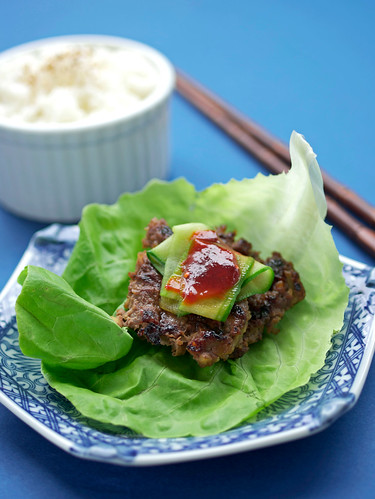
Wrap these beef in lettuce, dot with a chili sauce(gochujang).
Open your mouth as wide as you can,
and just put the whole thing in your mouth and savor it!
The beef, the nuts, the onions, the slight sweetness of soy sauce flavor.
Life feels much better when you get rewards after the hard work.

And this is the reward!


Korean Beef & Nut Patties
serves 4-5


1 1/4lb(500g) beef sirloin
2T Mirim(sweetened Korean rice wine)
3T pear pureed
2T onion pureed

1/2C walnuts finely chopped
3T pine nuts finely chopped
1/2C Asian leek (Daepa) chopped
1 garlic chopped
4T soy sauce
2T sugar
2t sesame oil
2t sesame seeds
3/4t pepper

Basting sauce
2T soy sauce + 1T honey + 1T sesame oil

1 Trim off the fat from beef and slice thinly across grain. Spread the beef slices around cutting board. Place cutting board on sturdy counter top. Smack them with knife in different directions. Turn over to the other sides and continue to chop the meat until you see them into small irregular chunks.

2 Place beef in a bowl and add pear and onion puree. Mix them well. Set aside for 10 minutes.
Add nuts, Asian leek, garlic, soy sauce, sugar, sesame oil, sesame seeds, and pepper to beef in a bowl.
Mix them thoroughly by squeezing or kneading them many times so the beef can soak up the marinade, about 5 minutes. Cover with plastic wrap and let it chill for at least 1 hr.

3 Heat your grill or grill pan over medium high heat. Spray with some oil. Scoop up the beef mixture with spoon and place it on the pan, flattening with your fingers, about 1/4" thick. Sear for 2 minutes and turn over to the other side. Continue to cook for another 1-2 minutes until you see the nice grill marks.

4 Before serving baste with the basting sauce to add shine and more flavor to the meat.
Serve immediately with some lettuce and Korean chili paste (gochujang) or ssamgjang.